

Emmy is a great name. It’s fun to get one. Like a Grammy, Oscar, or Tony. Collect all four, and you’ve entered that rare, elite stratosphere of talent known as EGOT.
EGOT.
Broadcasters have carried all four award shows for years, and they all failed at Scrabble. GOTE would be so much better.
GOATs in life could present to GOTEs, would-be GOTEs, and up-and-coming GOTEs. There’s your free programming idea for today.
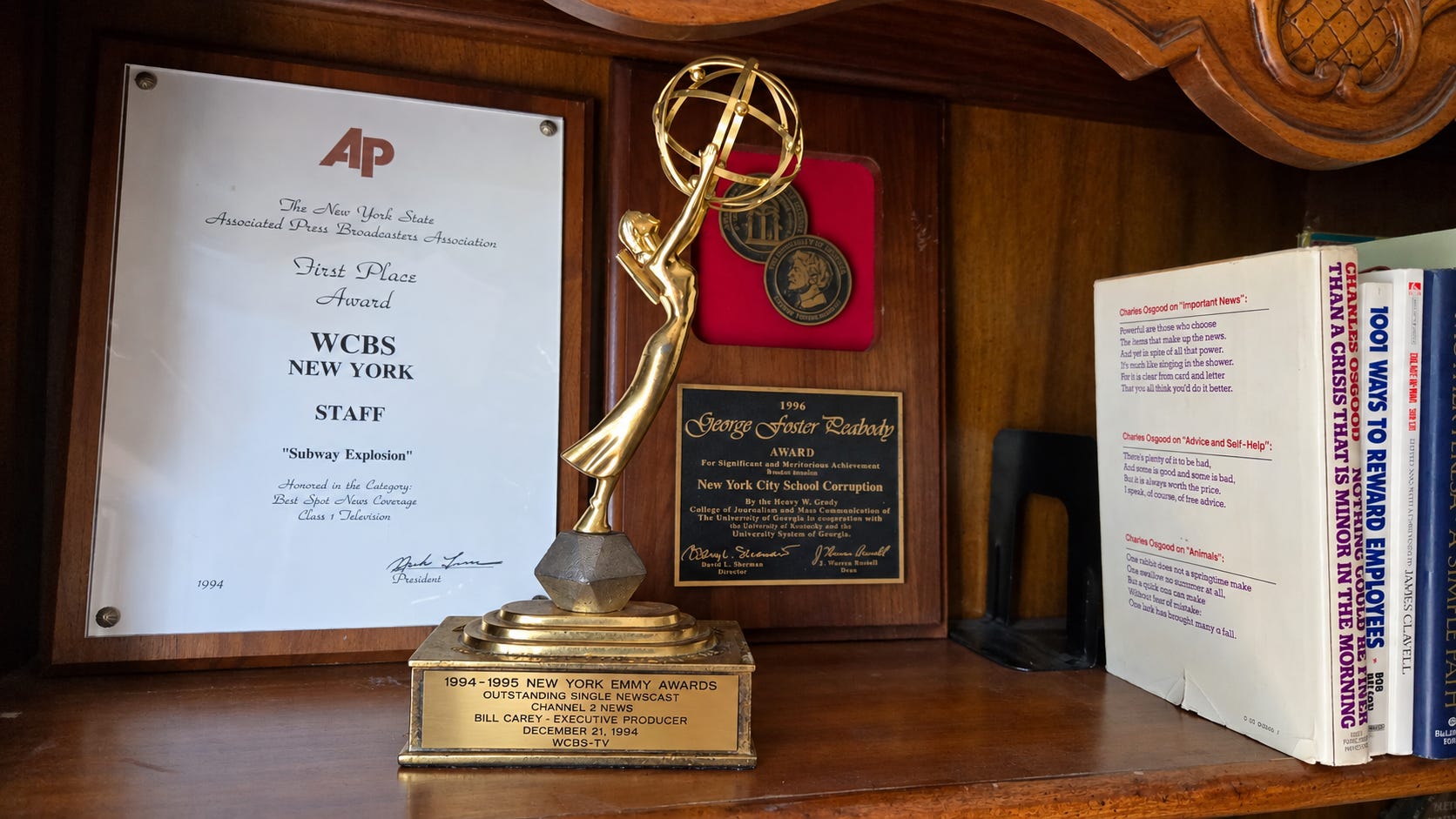
Now, when it comes to “E,” I have three. And my teams have won hundreds of Emmys over the years. I purposefully left my name off many team entries so I wouldn’t dilute the award for others. Just saying my teams have produced award-winning work is enough recognition for me.
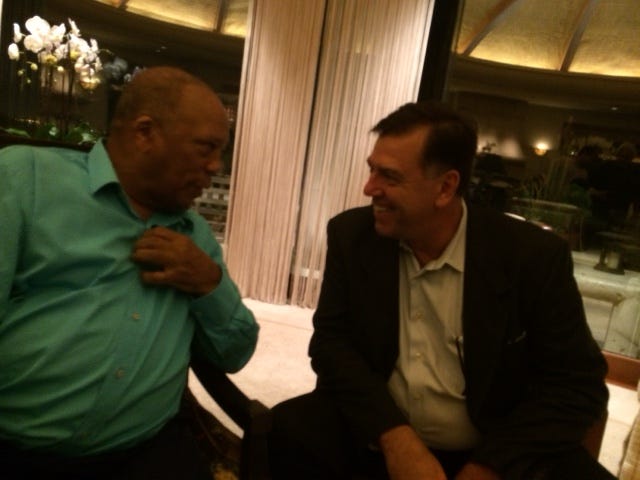
For the “G,” well, in 2014, I spent an evening with Quincy Jones talking about a business idea. A group of us was invited to his home. Off the grand room pictured here was an even grander room displaying his 28 Grammys.
For “O,” I have friends who produce the Oscars.
And for “T,” I served as a Tony voter from 1996 to 1999.
So, yes, I’m one for four.
But don’t you think more people would aspire to be a GOTE than an EGOT?
Is it a surprise that the national Primetime Emmy Awards are leaving broadcasting for Amazon? Does anyone care? The four networks, CBS, NBC, ABC, and Fox, have rotated the show for years. Next year, it’ll be on Amazon Prime Video. Free. No subscription required.
How did the networks manage to boot that one?
You mean to tell me they couldn’t create a spectacular live evening featuring stars from all four networks? Bring in Serena Williams, Michael Jordan, Tom Brady and other GOATs and GOTEs. Make it an event.
Produce something worthy of an Oscar. Er, umm ... an Emmy.
These shows should be must-see television, the way golf elevates its four majors or college basketball celebrates the Final Four.
I worked for CBS when William S. Paley was still very much interested in what went on at his company.
Mr. Paley was a pioneer. He helped build a radio, then television, broadcasting empire when there wasn’t a broadcasting industry to imitate.
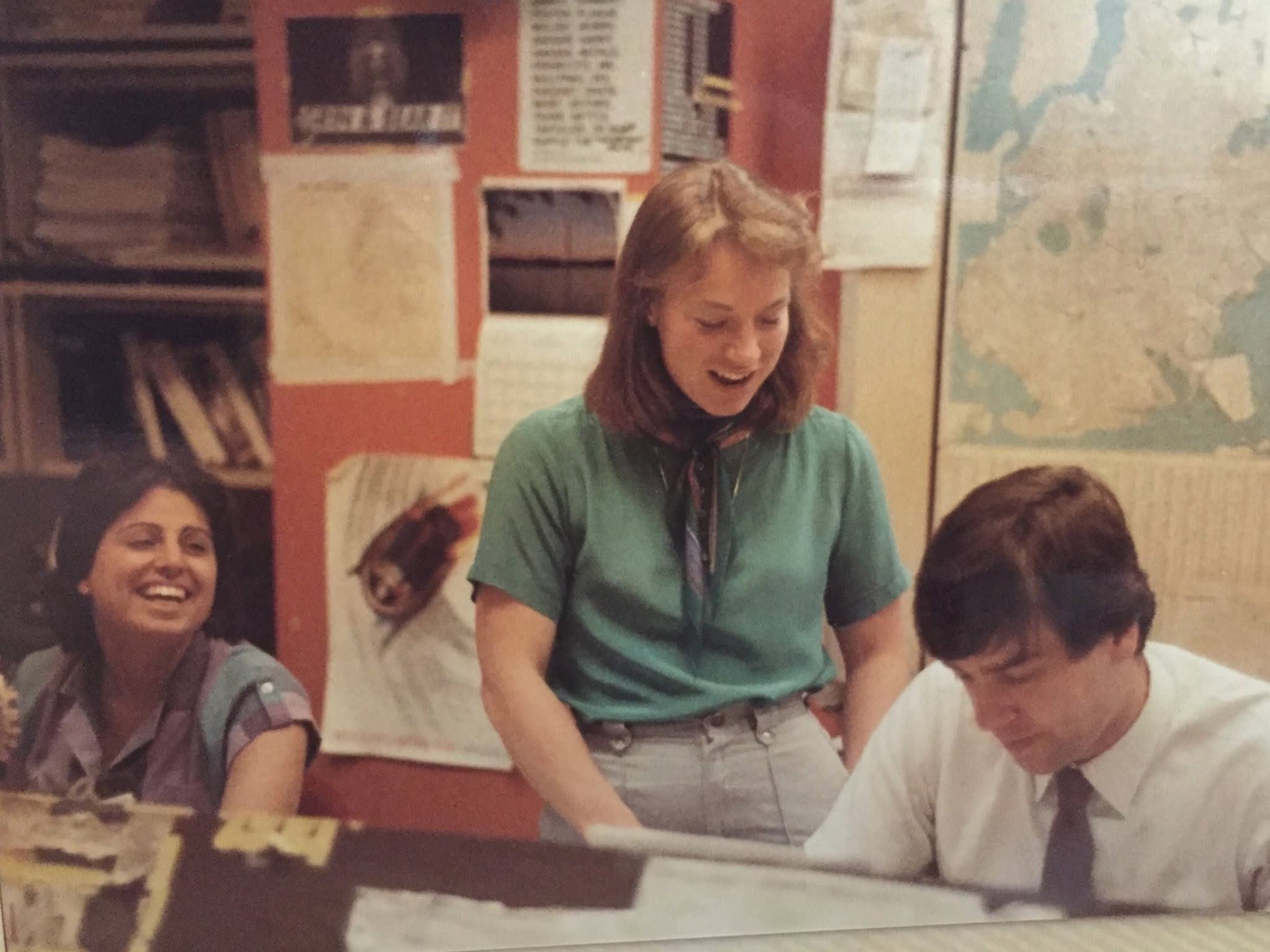
I was 23, working the evening assignment desk at WCBS-TV, when the telephone rang at the top of the eleven o’clock news.
“Bill!”
Let me tell you, the phone rang differently, more urgently. My spidey senses quickly learned it was Mr. Paley calling. He knew my name. Well, at least the first half of it.
“Who was the f*cking as*hole who wrote that story about the mayor and the Middle East trip?”
I’d learned to answer him without surrendering the fort.
“Mr. Paley, everybody’s in the control room. I’m working another story, trying to get a live shot up in Brooklyn.”
The truth saves you sometimes.
“Well, okay, Bill. Go do what you need to do. But I want everybody to know the mayor didn’t say that. And I’m watching.”
Click.
The next afternoon, my news director, Frank Gardner, a great boss and broadcast visionary, summoned me to his office. Ten CBS vice presidents, all dark suits, had gathered.
“Bill, these gentlemen want to hear you tell your story about Mr. Paley’s call last night.”
I’d already told our team and Frank the phone call details. I looked at Frank for permission. Did he really mean I should repeat, verbatim, what Mr. Paley had said? Was I even allowed to curse?
Frank nodded. All these years later, I love that nonverbal exchange between us.
I told the story.
One executive leaned in.
“Now, when Mr. Paley spoke, did he say ‘who was the FUCKING asshole,’ or ‘who was the fucking ASSHOLE’?”
My mind was on fire. So this is what broadcasting is all about! Oh, the things I need to learn!
Here were ten men who likely made more in a month than I did in a year, trying to decode the boss’s emphasis. Though Mr. Paley and I hadn’t met, suddenly I felt like his protector. I wasn’t about to give him up. And what if I interpreted it wrong?
Writing this now, I realize how much I helped my standing at CBS by letting ten vice presidents know William S. Paley and I were on a first-name basis.
My first name. Not his.
Mr. Paley belonged to a generation that invented things. And protected what they invented.
I always liked that he watched the late news. I never saw it as pressure when the phone rang. Getting it right was the point of Mr. Paley’s phone call, not which word he’d emphasized. Frank took care of that and never worried about voice inflection.
By the way, the emphasis was, and should be, on the second word. The first delivers the shock. The second needs the emphasis to keep up.
Basic stuff the suits should have learned on their respective playgrounds in Queens or Brooklyn.
In 2004, I arrived in Tampa to run the ABC affiliate. Terrific station, talented people, and we did very well. As a new general manager, I was invited to speak to the Broadcast Pioneers Club.
About thirty retired broadcasters attended the luncheon, most in their seventies or older. True pioneers who, like Bill Paley, helped invent network television.
They made it up as they went along.
I spoke for fifteen minutes and stayed another three hours.
They listened attentively, then kept the Q&A going well past the restaurant’s allotted time. As things wound down, four or five of the leaders kept me at their table.
Mostly, I listened.
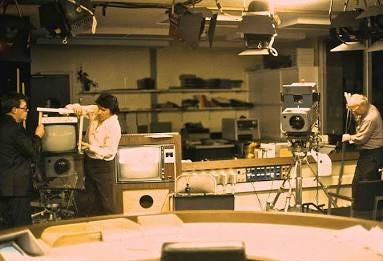
Some had worked at CBS’s Broadcast Center at 524 West 57th Street. Studio stagehands, production managers. A few had even worked at the earlier CBS studios in Grand Central Terminal, on Vanderbilt Avenue.
I’d spent almost twenty years at 524 West 57th, leaving in 1999 as news director. When I started in 1979, it was as a security guard. I knew every corner of the building, down to the abandoned Hudson line train tracks running in the off-limits sub-basement.
When I left, I left as news director of WCBS-TV. Frank’s one-time job. Frank’s one-time office.
I was fascinated with the table, and they accepted me once they knew I knew my way around.
One more story, and their eyes lit up. Another story, more bright eyes.
They wanted to know everything. Some didn’t know the old local newsroom had become the lobby in the early ‘80s, or that “local” was now adjacent to Studio 46 “upstairs.”
We were comparing notes on the same building, separated by a generation.
Their stories were inspiring. They didn’t have budgets for props, so they brought kitchen utensils and hand tools from their homes and garages. Whatever it took to make something work.
Defeat wasn’t in their vocabulary.
I wanted my colleagues back at the station to hear them. Even in their retirement, I wouldn’t have wanted to compete against the creativity and smarts sitting at that table.
And something else struck me and has stayed with me.
Whenever I started criticizing the business, they smiled, waited politely for me to finish, and returned to their upbeat memories. Their experiments. Their successes. Even their failures.
They weren’t interested in complaining about what television had become. They were still excited about what it could become.
I realized they might have handled the maturing of the industry better than I had.
A damning admission from a general manager, but there it is. I’d spent an afternoon with the GOATs of broadcasting.
I have no doubt they would have looked at “EGOT” and said, “Nope. GOTE.”
That’s what pioneers do. They don’t begin with the reasons an idea can’t work. They make use of what’s available, reconfigure it, then make certain it will work.
There are legitimate reasons for caution in business. But caution shouldn’t become a substitute for imagination.
The networks didn’t lose the Emmys because Amazon invented a better trophy or conceived a better live program.
Broadcasters have driven droves of viewers away after decades of failing to imagine better television. Driven other droves to bed early with rote, not GOAT, formulaic newscasts.
I’ll have more to say about that in the future.
Gotta go. Amazon just delivered something at my door.
Management and Wisdom.
Two different words for good reason.