
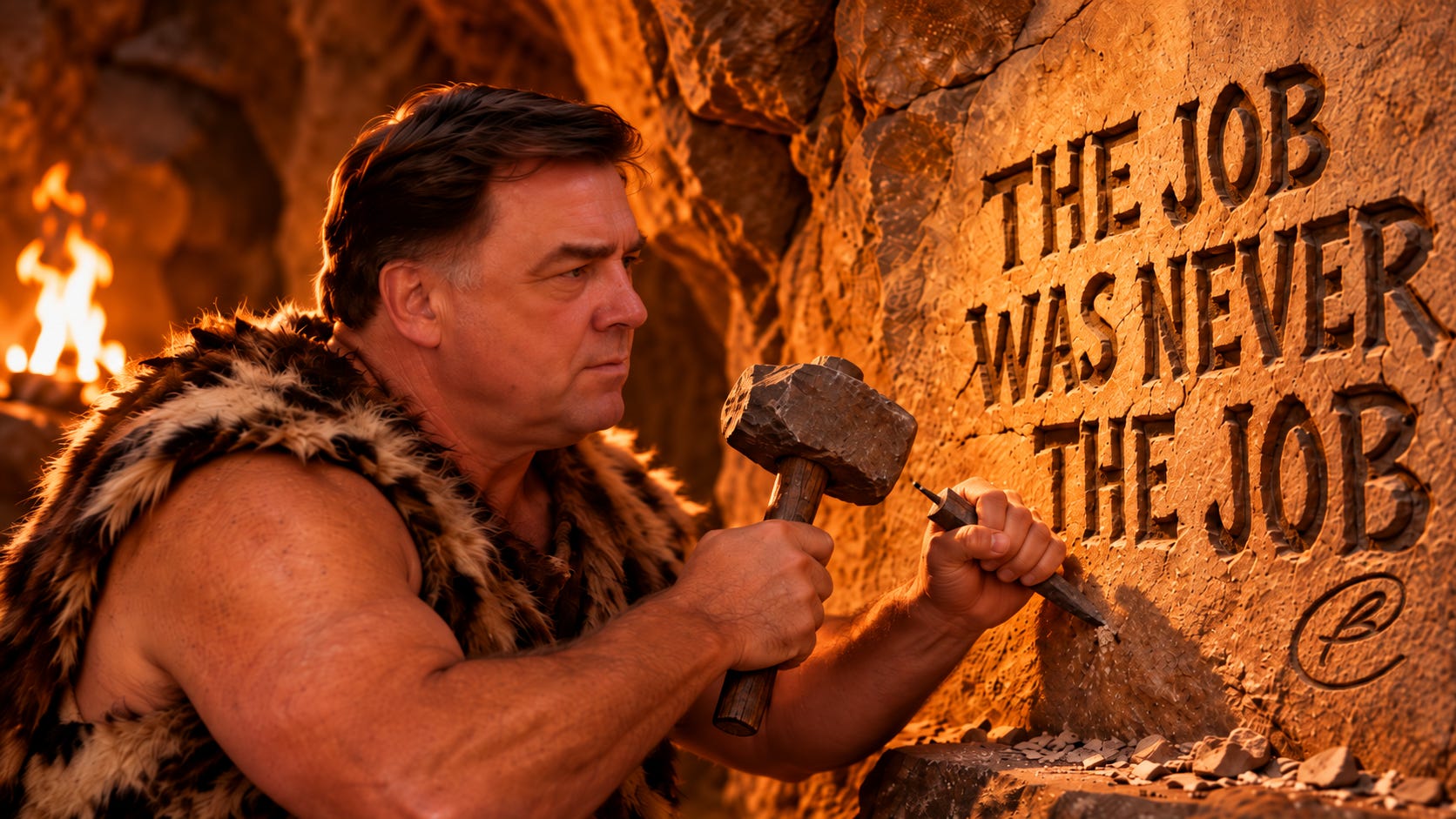
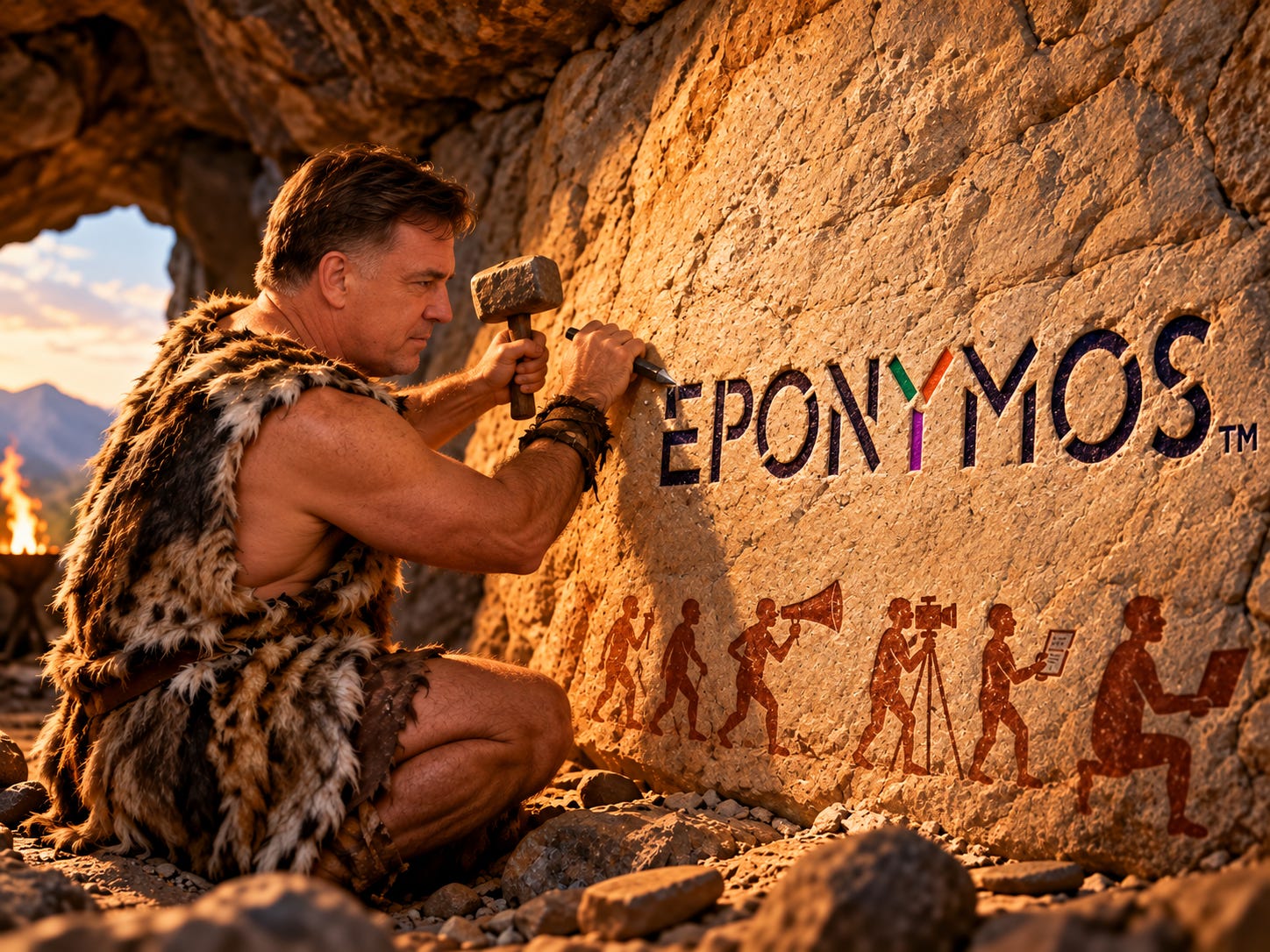
Somewhere, somebody once sharpened a rock.
There was probably another guy standing nearby saying this was going to ruin everything, and, where are you going to find someone that knows how to use the rock?
Before PowerPoint, before Microsoft Word, before the printing press, before movable type, somebody picked up a hammer and chisel and discovered that telling the story on the cave wall went a little faster if you had the right tools.
Tools have always been part of the job.
The mistake is confusing the tool with the job.
A reporter’s job was never the typewriter. A carpenter’s job was never the hammer. A bank teller’s job was never counting twenties by hand.
The job was the result.
The tool was how we got there.
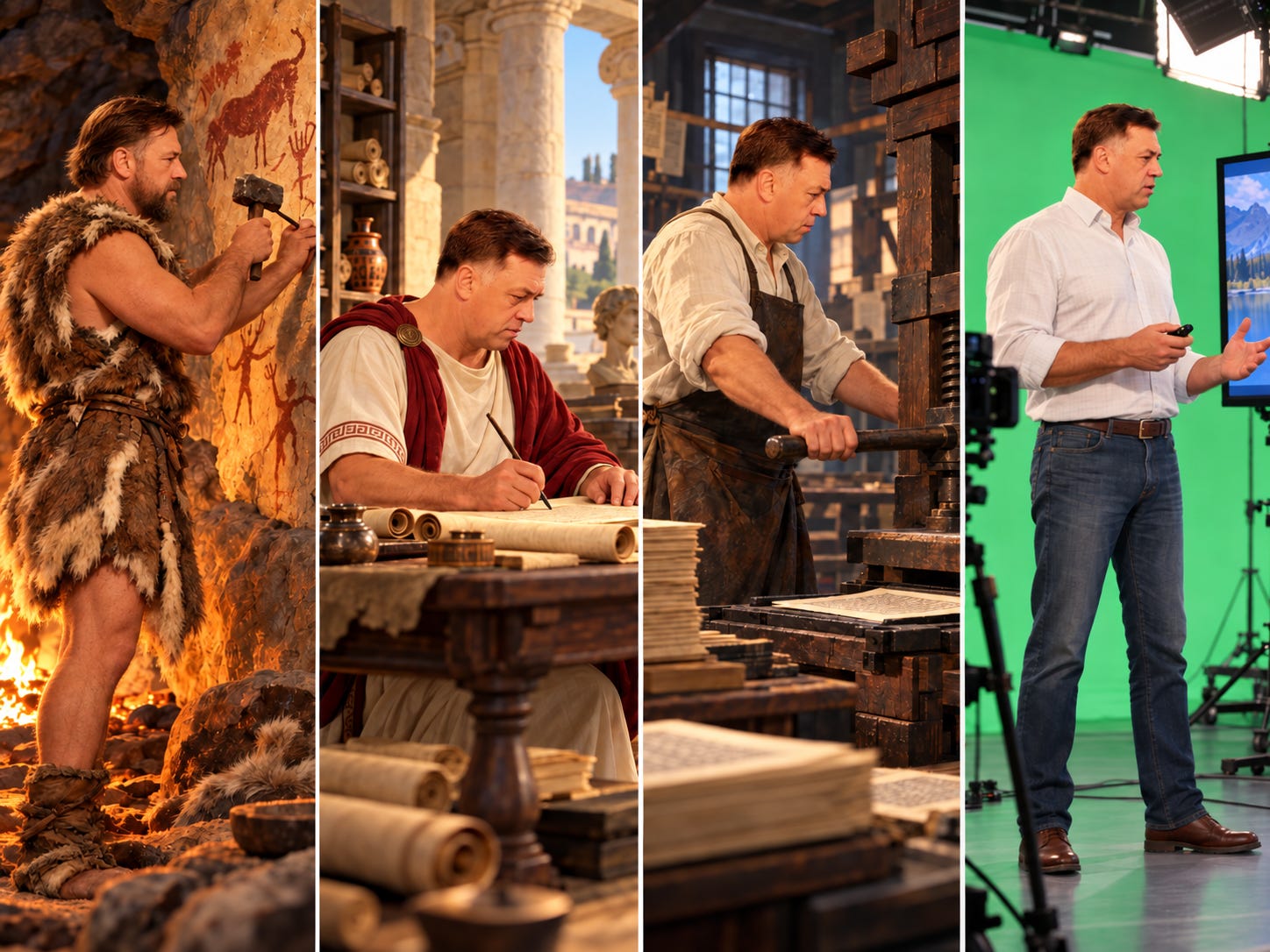
Through the ages, the job was never the tool.
Artificial Intelligence is not different in that respect.
What is different is the speed.
The Industrial Revolution came like a hurricane. You could see it offshore. Factories appeared. Railroads spread. Cities grew. Generations of workers moved from farms to mills and eventually into offices.
Enormously disruptive.
But much of it unfolded over decades.
By contrast, AI feels more like a tornado.
The sky gets strange. Somebody says they heard something. Then your neighbor’s garage is in someone else’s backyard.
In 1970, futurist Alvin Toffler gave the feeling a name: Future Shock. His argument was that people could become disoriented when change arrived faster than they could comfortably absorb it.
He saw the acceleration.
He couldn’t have imagined ChatGPT sitting on my laptop helping me write about Alvin Toffler before breakfast.
And yes, I used AI to assist with this column.
I researched with it. I challenged things I thought I knew with it. I asked it to find a study I remembered seeing.
It found one.
Then another.
This story is better because I used AI. The work was done faster, it saved me time.
That sentence itself apparently requires a disclaimer now.
Good AI.
We increasingly qualify the term the way we might say “good cholesterol.”
By good AI, we mean the kind that does not steal your job, impersonate your daughter, eliminate humanity or make off with the bacon while you sleep.
We did something similar with the internet.
For years we heard relationships had been destroyed because somebody “met someone online.”
“Online” didn’t destroy a relationship.
A person met another person.
The internet simply provided a more efficient bar.
AI is acquiring the same villainous supernatural powers.
Someone loses a job: AI did it.
Someone sends a terrible memo: AI wrote it.
A company handles a technology rollout badly: AI destroyed the culture.
Unlikely.
More likely, the tool was misused.
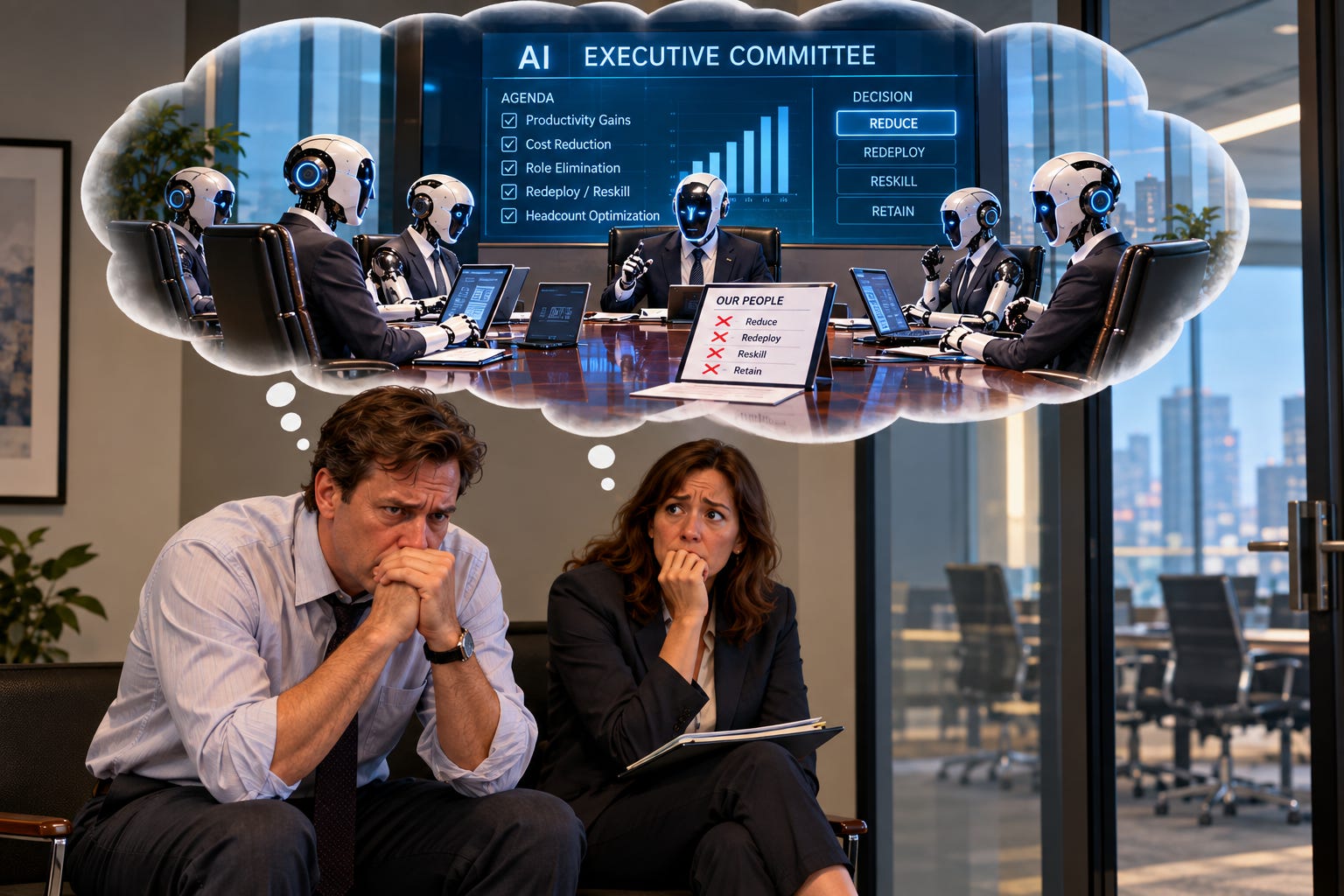
Sometimes the scariest AI is the one in our minds.
A new Culture Amp benchmark gives that distinction some weight. Its data came from about 112,000 employees across 123 organizations. Seventy-one percent said AI made them feel more productive. Among the heaviest users, that rose to 93 percent.
But here is the management number.
Eighty-five percent said their companies encouraged experimenting with AI.
Only 58 percent said leadership had clearly explained how AI connected to the company’s goals. Culture Amp
The tool arrived before the explanation.
Gallup found something remarkably similar. Employees whose managers actively supported AI use were more likely to say their workplace culture had improved. Yet half of the CHROs Gallup surveyed said they were not confident managers could effectively guide employees in using AI. Gallup.com
This morning, an email about workplace burnout landed in my inbox.
Buried in it was a line worth stealing — or, since we’re talking about AI, perhaps I should say properly attributing:
“AI is whatever your workplace makes it.”
Exactly.
A hammer can build a house.
It can also put a pretty good dent in your thumb.
We never blamed the hammer.
And I don’t fear tools.
I use them.
I’ve spent a career doing that.
Cameras got smaller. Editing moved from razor blades to keyboards. Newsrooms went digital. The internet arrived. Streaming arrived. AI arrived.
Every time, the useful question was essentially the same:
What can this help me do better?
That is very different from asking:
What is this going to do to me?
Both questions are human.
But management has enormous influence over which one employees ask first.
The managerial temptation is to start with the technology.
“How do we get everybody using AI?”
Wrong question.
Start with the work.
What are we trying to accomplish?
What takes too long?
What adds no value?
What keeps talented people doing mechanical things instead of thinking?
What can a machine do faster so a person can do something better?
Then introduce the tool.
And explain why.
AI isn’t the management decision.
AI is the tool management is deciding how to use.
The job was never the job.
The job description, the workflow, the process, the software and the org chart are temporary agreements about how we get something done.
They feel permanent because we live inside them.
Until somebody sharpens a new rock.
Alvin Toffler warned us the problem would not merely be change.
It would be the speed of change.
He was right about that.
The tornado is here.
Management cannot stop the wind.
Wisdom is figuring out what should still be standing when it passes.
This one has personal relevance.
For the past few years, I’ve led a group of people who believe the communications and PR business is overdue for some better tools.
In about two weeks, Eponymos will show what we’ve been building.
I won’t spoil the reveal here. You can drop me a DM.
The premise behind it fits today’s column almost perfectly.
Communications people should spend more of their time thinking, deciding, creating, advising and executing strategy — and less of it performing mechanical work simply because that is how the job has always been done.
We’re not trying to replace the communicator.
We’re trying to give the communicator a better hammer.
Eponymos. So easy to use, even a…