

News Item: San Jose is courting more AI data centers, each potentially worth $3 million to $6 million a year in tax revenue. Neighboring Santa Clara already has about 60. Reuters

San Jose is a place where many smart people became rich making things nobody could see. And very smart people became very rich inventing those things.
A modern California gold rush. No pickaxes, just computers and garages.
Then garages with Lambos.
A dizzying array of new words: software > Apps > Search engines > Social networks > Algorithms.
Wonderful things made newer, faster, even more wonderful things, always the promise of another problem solved, a better life, built with as few people as possible.
For a while, almost everything fit very neatly inside a laptop.
Until it didn’t.
Bigger laptops. External drives. Server rooms. Data centers. Acres for many data centers.
Lots of electricity and water needed.
In California, where water is a thing!
One particularly smart fellow was sitting in one of those sleek Silicon Valley offices one afternoon, searching for inspiration through a spotless floor-to-ceiling window. He knew taking rows of crops and turning them into rows of servers might not sound all that appealing.
Especially in his own neighborhood.
He looked up.
There it was. A big, puffy, white-on-white, completely untouched cloud.
“The cloud,” he said.
Immediate acceptance.
Cloud. What a happy word.
Somewhere, George Carlin was smiling.
Certainly better than enormous windowless buildings filled with racks of computers consuming enormous amounts of electricity twenty-four hours a day, seven days a week, no PTO, no morning or evening break, annnnd, no… health, life, day care, gym, 401(k), or hot lunch benefits!
The cloud grew and grew.
People put messages in it. What they had for breakfast.
Then emails.
Then pictures of their breakfast.
Then tax returns. Medical records. Movies. Music. Passwords. Doorbell videos. PowerPoints.
And archives.
Dating back to pre-archival times.
Then came artificial intelligence.
The cloud got heavier.
Nobody worried much about it.
Nobody except Big Chick.
He had been a worrywart ever since he was little. The family said he could look at a blue sky long enough to turn it gray.
Meanwhile, the mayor was looking across at neighboring Santa Clara and its 60 data centers and praying above that San Jose could catch up.
Millions of dollars in tax revenue.
Money!
The mayor knew that cloud needed a home.
A taxable home, inside city limits.
Acres of servers inside acres of data centers.
Yet many still called it by its happy name, the cloud.
Parts of the puffy white cloud started turning gray and gnarly.
Where endless hours of political cable talk gathered. Always gloomy there.
The air was especially hot in the podcast section of the swishy cloud.
People recorded themselves watching other people recording themselves.
While doing their lashes.
Then came the dancing babies.
Big Chick kept looking up, pointing.
“The cloud is getting awfully low,” he said.
“Nonsense,” said one of the experts. “The cloud is scalable.”
Until one day, at exactly 3:16 in the afternoon, a TikTok appeared featuring a fellow named Beta Belly, performing a dance move that no adult man should attempt without first consulting an orthopedic surgeon.
This was, and always will be, Mr. Belly’s 28 seconds of fame.
Replayed indefinitely.
That did it.
The cloud could hold no more.
Unnamed but double-confirmed sources quickly blamed China.
Congress scheduled hearings before anyone had decided what the hearings were about.
Big Chick saw it first, nervously pointing up.
“The cloud is falling!”
Nobody moved.
“The cloud doesn’t fall,” the mayor mansplained.
“The cloud is virtual,” techsplained the software engineer.
“The cloud is infinitely scalable,” Investor Relations reassured all.
Then it hit San Jose.
Not with thunder.
With a thud.
Tiny TikTok videos littered rooftops. Some whole. Some in pieces.
Emails hung from trees like a wild T.P. raid after homecoming.
Strings of passwords balled up in storm drains.
A PowerPoint landed on a Tesla. Twenty-five slides, heavy with graphs.
All 58 versions.
Quite a dent.
And as the wind blew the messy fog away, there they were: those enormous buildings everybody had managed not to think very much about, that the cloud had left behind before it disappeared.
Now the mayor had his buildings, more data centers than any city in the state.
One wish down, one nightmare forming.
Electricity. Water. Talk of limitations for residents.
Big Chick looked around.
“I thought the cloud was uncrashable,” he moaned.
Nobody answered.
Because nobody had done anything especially foolish.
Nobody was especially bad.
The inventors had invented.
The investors wanted a return.
The builders wanted to build.
Teams had assembled to solve every problem put in front of them, and they had been very good at it.
That is how progress happens.
It is also how progress can get away from you.
Then what?
What happens if it works?
If it works too well? Scales too quickly?
We’ve seen this before.
The Industrial Age produced bigger, faster, better things too.
Put the big new factory along a river. Let the waste run. Next thing you know, it’s not a moral question, it’s part of the business plan. We’ve lived through the cleanup.
Fables are fun. History is useful. But let’s switch to real life.
I am proud to say one of our clients at Eponymos is the Samuel Lawrence Foundation.
SLF is a nonprofit in San Diego fighting the good fight, demanding that America come to terms with nuclear waste. It wasn’t a surprise. We knew we didn’t have the back half solved when we turned the switch on.
A ’70s version of the cloud fable.
Home for SLF is San Onofre.
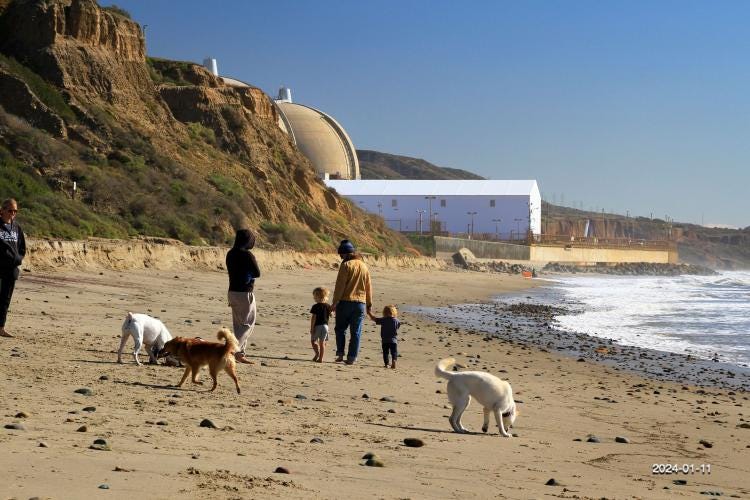
The reactors are shut down and being decommissioned.
The waste remains.
This isn’t a debate about whether nuclear power is good or bad.
It is about what is left behind.
Radioactive waste exists.
It is dangerous.
It requires a safe, long-term solution.
Millions of pounds of spent nuclear fuel remain there, stored 100 feet from the Pacific Ocean.
The front half of the plan was built.
The back half was never finished.
Isn’t finished.
If Eponymos does its job right, you’ll be hearing a lot more about this cause.
And if you’re running the room, give some thought to having your own Big Chick.
Somebody with a seat on the Board or in the C-Suite.
Somebody you have to contend with.
Somebody allowed to ask the question everybody else is too busy, too excited or too invested to ask:
Then what?
You may not always like Big Chick.
That may be the point.
And for any new idea, the moral of this tale remains the same:
The best time to figure out what happens after success is before everybody succeeds.